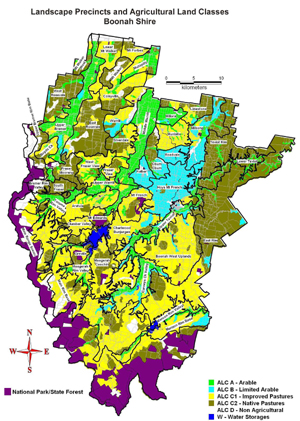
Rural Landscape Precincts in Boonah Shire
Boonah and Esk Shire Councils commissioned LRAM to undertake separate rural land studies to assist them in protecting the rural production capacity and economic base and objectively determine the minimum lot size for the various rural zones within each shire.
LRAM used existing soil mapping, agricultural land suitability assessments and regional vegetation mapping by Queensland Government departments to identify and map Rural Landscape Precincts. A precinct has, or is capable of having, a distinctive suite of commercial rural land uses based on the range of natural resources, existing land use and environmental characteristics within its boundaries.
Rural Landscape Precincts in Boonah Shire
LRAM then analysed existing cadastral data and rural economic models to compare current lot sizes with viable production areas for horticulture and grazing enterprises in order to recommend minimum lot sizes for each precinct.
Viable horticultural farm vary from 60 ha for large vegetable growers who subcontract with small growers to 20 ha for growers relying on direct sales to the Brisbane Markets. The data suggests that 3 lots per land holding is the norm in the horticulture industry. A sensible compromise which would effectively halt small lot subdivision and allow horticultural growers to incrementally expand and remain viable under contract prices to large vegetable growers and under direct supply to the Brisbane Markets appears to be 20 ha.
Within the grazing areas, current livestock price based models indicate that land holdings of between 300 and 500 ha would produce positive returns on the investment with properties of 500 ha or greater being capable of supporting more than one family unit.
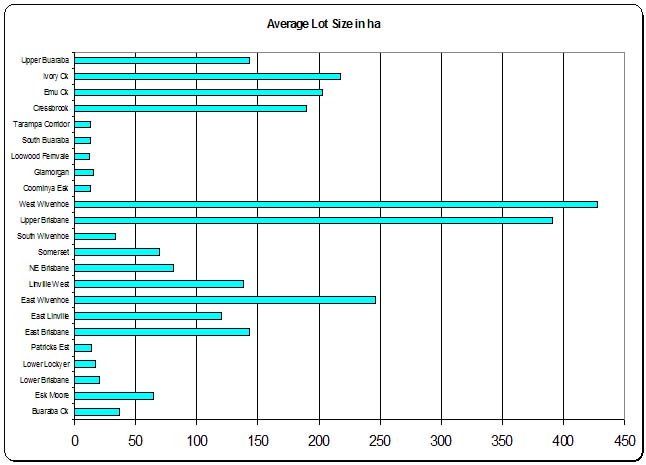
Lot size analysis for each Landscape Precinct in Esk Shire